
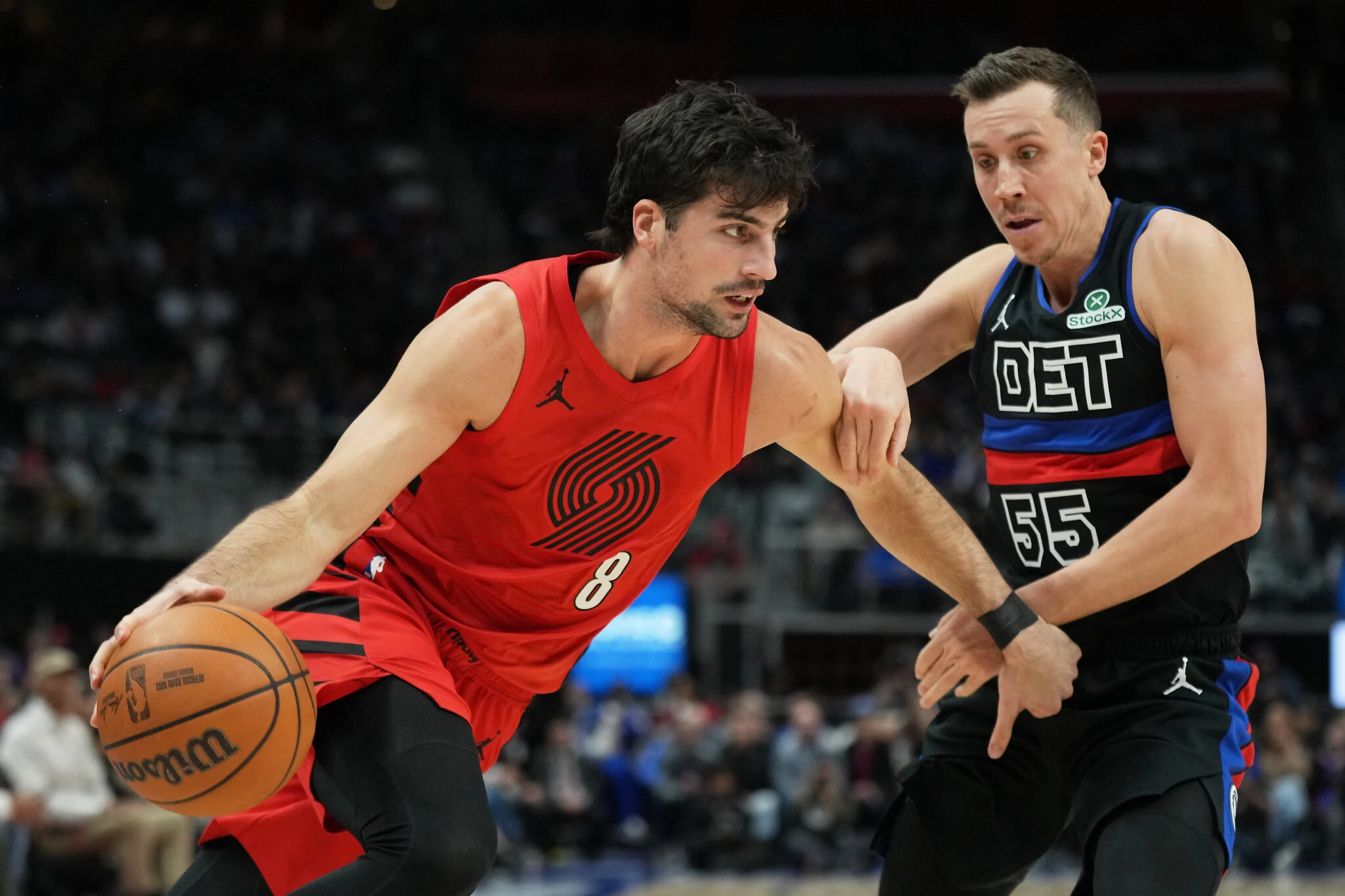
Comparisons to legends appear early and stick hard. Young NBA players are often measured against icons long before they define their own game. That pattern shows up again with Deni Avdija, whose name has occasionally been placed next to Kobe Bryant. The comparison sounds bold, but it says more about expectation than reality.
Media cycles push narratives that are easy to understand. Calling someone “the next Kobe” draws attention and simplifies a complex evaluation into a headline. Fans then adopt the label, and the player inherits a standard that few in history have met. The gap between expectation and actual role becomes difficult to close.
Avdija entered the league with a different profile from most players who receive this type of comparison. He was not drafted as a primary scorer or a takeover player. He came in as a high-IQ forward who could defend multiple positions, move the ball, and fit into structured systems. Those traits do not match the traditional mold of a volume scorer who builds a career on isolation offense.
The cultural element adds another layer. Avdija carries national attention as one of the most prominent Israeli players in the NBA. That visibility increases scrutiny. Each performance is interpreted not only as part of a team context but also as part of a broader narrative about representation. When expectations are already high, comparisons to legends amplify pressure rather than clarify potential.
The early signs that triggered the Kobe comparison were selective. Observers pointed to competitiveness, defensive effort, and flashes of confidence. Those are useful traits, but they are not unique. Many players show similar attributes without becoming generational scorers. The leap from strong fundamentals to elite offensive dominance remains large.
The Kobe Blueprint — What Made Kobe, Kobe
Kobe Bryant’s career followed a path that is difficult to replicate. He built his identity around scoring, control of the game, and relentless self-improvement. His offensive skill set expanded every year, driven by repetition and refinement rather than sudden breakthroughs.
His scoring profile was defined by shot creation under pressure. He could generate offense in isolation, in the post, or off movement. Defenses knew where the ball was going, yet still struggled to stop him. That level of predictability combined with efficiency is rare. It requires both technical mastery and psychological resilience.
Bryant’s work ethic is often described as extreme, but the more relevant point is consistency. He trained with purpose and focused on details that others ignored. Footwork, timing, balance, and shot selection became second nature through repetition. His preparation allowed him to execute in high-pressure moments without hesitation.
Another defining trait was decision-making under stress. Bryant took difficult shots, but he understood when those shots were necessary. He read defensive schemes and adjusted in real time. That ability separated him from players who could score but struggled to manage the flow of a game.
His development also benefited from context. Early exposure to high-level competition, strong coaching, and a competitive team environment shaped his growth. He entered the league young but adapted quickly because his foundation was already advanced.
Not all of these traits are transferable. Work ethic can be trained, and skill development can be structured. However, instinctive scoring ability at Bryant’s level is rare. It combines physical tools, mental processing speed, and a specific mindset that prioritizes taking control of possessions.
Deni Avdija’s Real Profile — Not the Hype Version
Deni Avdija’s game is built on versatility rather than dominance. He contributes across multiple areas without relying on one primary skill. That makes him valuable in team systems but limits direct comparisons to players who define games through scoring.
His defensive ability stands out. Avdija can guard multiple positions, switch onto different matchups, and maintain discipline within team schemes. He uses positioning and awareness rather than raw athleticism to stay effective. Coaches value players who can execute defensive plans without constant adjustment.
His basketball IQ is another strength. He reads plays early, moves the ball quickly, and avoids forcing low-percentage shots. In transition, he makes efficient decisions that create opportunities for teammates. His passing is not flashy, but it is reliable and purposeful.
His offensive limitations are just as clear. Avdija has not developed into a consistent scoring option. He can attack closeouts and finish in space, but he does not yet create high-quality shots in isolation. His handle is functional, not elite. His jump shot has improved but remains inconsistent under pressure.
Aggression is a recurring issue. At times, Avdija defers when the situation calls for initiative. He prioritizes team flow over individual scoring, which can be positive in structured systems but limits his ceiling as a primary option. Players who lead offenses must balance efficiency with assertiveness.
His role in the NBA reflects these traits. He is often used as a connector rather than a focal point. He supports lineups, stabilizes possessions, and contributes defensively. That role has value, especially on competitive teams, but it differs from the path taken by players who become offensive leaders.
Data supports this evaluation. His usage rate remains moderate, indicating that teams do not rely on him as a primary scoring option. His efficiency fluctuates depending on role and lineup context. His defensive metrics, however, consistently show positive impact, especially in matchups against versatile wings.
The Core Question — Can He Actually Become “The Next Kobe”?
The comparison between Avdija and Kobe Bryant breaks down under direct analysis. Their roles, skill sets, and developmental paths differ from the start. Kobe entered the league as a guard with elite scoring instincts. Avdija entered as a forward focused on defense and ball movement.
At similar career stages, Kobe was already pushing toward offensive leadership. His scoring output increased each season, and his role expanded accordingly. Avdija, by contrast, has maintained a supporting role. His growth has been steady but not centered on scoring volume.
The difference in mindset also matters. Kobe embraced high-pressure situations and actively sought control of the game. Avdija plays within structure and often prioritizes efficiency over risk. That approach fits certain team environments but does not align with the profile of a dominant scorer.
The modern NBA context adds complexity. Offensive systems are more collaborative, and roles are more specialized. Teams value players who can switch defensively and contribute without high usage. Avdija fits this model well, but it is a different model from the one that defined Kobe’s era.
Physical tools play a role as well. Kobe combined athleticism with advanced footwork and balance, allowing him to create separation in tight spaces. Avdija relies more on positioning and timing. His physical profile supports versatility but not elite shot creation.
Coaching and team context influence development. Players become what their teams ask them to be. If a player is consistently used as a connector, they develop that skill set further. Transitioning from that role to a primary scorer requires both opportunity and a shift in approach.
Alternative comparisons provide more realistic benchmarks. Players who succeed through defense, passing, and secondary scoring offer a closer match. These players contribute to winning without dominating the ball. They can reach high levels of impact without leading the league in scoring.
A Better Question — Who Will Deni Avdija Actually Become?
The more useful question focuses on Avdija’s own trajectory. Measuring him against Kobe Bryant sets a standard that does not match his profile. Evaluating him on his own terms provides a clearer view of his potential.
One realistic path is becoming an elite two-way forward. In this role, Avdija would anchor defensive schemes, handle secondary playmaking duties, and contribute efficient scoring within the flow of the offense. Players in this category often play key roles on competitive teams.
Another path involves expanding his offensive responsibility without becoming a primary scorer. If he improves his handle and shooting consistency, he can create more opportunities for himself while maintaining his team-first approach. This would increase his value without requiring a complete shift in identity.
Consistency remains the main area for growth. Avdija shows flashes of high-level play, but sustaining that level across games and seasons is critical. Improvement in shooting mechanics and confidence would support this goal. Small gains in efficiency can have a large impact over time.
Aggression must be developed carefully. He does not need to become a high-volume shooter, but he must recognize moments when taking control benefits the team. Selective assertiveness can raise his ceiling without disrupting his strengths.
His long-term projection depends on incremental improvement rather than transformation. Players who build on existing strengths while addressing specific weaknesses often achieve stable, high-impact careers. Avdija fits this model.
External pressure will continue to shape perception. Comparisons to legends will not disappear, but they do not define outcomes. Players who succeed in the NBA often do so by refining their own identity rather than imitating others.
In practical terms, Avdija’s ceiling may resemble a high-level starter on a playoff team, with occasional All-Star consideration if his offensive game develops further. That outcome represents significant success, even if it falls short of generational status.
At a certain point, the conversation shifts from comparison to contribution. Teams value players who help them win, regardless of narrative. Avdija’s strengths align with this goal. His development will be measured less by headlines and more by impact on the court.
The comparison to Kobe Bryant will likely remain part of his story, but it should not define it. The more accurate measure of success is whether he maximizes his own skill set and adapts to the demands of the league.
That perspective allows for a clearer evaluation. Avdija does not need to replicate a legend to have a strong career. He needs to refine his game, expand his role where possible, and maintain the qualities that brought him to the NBA.
Even in environments far removed from professional basketball, people understand the value of defined roles. In a busy setting, someone who organizes, supports, and maintains structure often contributes as much as the person in the spotlight. The same principle applies on the court, where not every player needs to dominate possessions. The balance between roles, much like arranging restaurant chairs in a dining space to support flow and function, determines how well the system works.
Avdija’s future will be shaped by how he balances growth with identity. If he continues to improve his scoring while maintaining his defensive and playmaking strengths, he can reach a high level within his own category. That path may not match the narrative of becoming the next Kobe Bryant, but it offers a realistic and valuable version of success.
